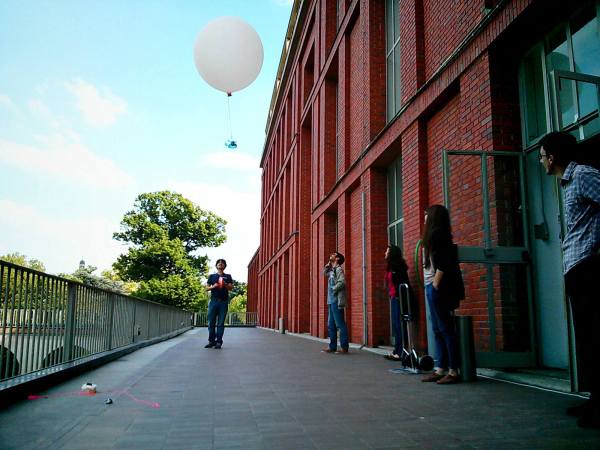
Aerial Mapping at Triennale
In May 2013 I organized with my partners at Wefab, a 2-day workshop of DIY Aerial Mapping to introduce to
In May 2013 I organized with my partners at Wefab, a 2-day workshop of DIY Aerial Mapping to introduce to
At the end of July I spent a week at Supsi with Massimo Banzi and around 20 participants at the Physical & Wearable computing with Arduino summer school. The focus of the course was on the design and prototyping of digitally fabricated interactive objects. It was the first time I was working with Massimo and some weeks before I shared with him the approach I had in mind. Usually, wearable technology workshops start from ready-made garments or accessories. Old gloves and t-shirts, cheap belts or jackets are “decorated” with technology. I wanted to experiment a different point of view. I would have brought some rough prototypes of wearable accessories made of felt and produced with a lasercut. I prepared the files during the previous months with the help of professional tailor Nadia – who knows much about measures and fit, and Vectorealism, my partners at Wefab – who gave me direct access to the lasercut to prepare the first drafts.
read more From the idea to the prototype with the help of open design
(Segue in italiano) When a couple of years ago I got interested in the development of the first open-source loom and interviewed Margarita Benitez of Osloom I suddenly realized the potentiality of weaving, knitting and crocheting in terms of modularity and flexibility. Now i’d like to present you two other projects that got my attention. They are not open-source, they are proprietary projects, but they show us how companies are researching and investing in new patented technologies that are revolutionizing the field. Start with watching these videos. the first is a glance on the Nike’s Flyknit technology and the second is a short interview with the designers who developed it. They show us the first example of the knitting of one piece of trainer uppers using flat and circular knitting technologies. The shoe weights only 160 grams and has multiple yarns of varying properties! Nike Flyknit technology film from Darrin Crescenzi on Vimeo. If you want to know more technical
Articolo originariamente pubblicato su CheFuturo Ne sono certa, ci sono tante cose che possiamo fare per innescare la rivoluzione di cui abbiamo bisogno. L’articolo di Massimo Banzi è un’altra prova del fatto che l’innovazione in Italia non sia un fantasma. Anche io qualche giorno fa ho lanciato una proposta all’interno della discussione pubblica per l’Agenda Digitale Italiana: creare un Istituto per la Manifattura Digitale. Il suo compito? Finanziare e pianificare per i prossimi 10 anni l’apertura di laboratori d’innovazione focalizzati su open design, manifattura sostenibile e artigianato digitale. Potete commentare l’idea e votarla se siete d’accordo. So cosa volete chiedermi: ma in un paese come l’Italia un istituto del genere serve davvero? Sì, perché investire su creatività e tecnologia rappresenta un’opportunità che non possiamo ignorare ma, allo stesso tempo, non è un’impresa facile. L’entusiasmo con cui vengono raccontate le storie di innovazione e startup a volte ricorda un po’ la retorica dei “due cuori e una capanna”. Nel caso delle
read more Perché ho chiesto a Passera e Profumo un FabLab in ogni città
Article originally published on Digicult – Articolo originariamente pubblicato su Digicult “I see no future without technology, but even future without nature, they must find a balance at some point.” This is the statement by Markus Kayser, German designer with a studio in London, who with his latest project Solar Sinter, has won the Arts Foundation Fellowship 2012 (http://artsfoundation.co.uk/Artist-Year/2012/all/318/Kayser) for the Product Design category and was shortlisted for the prestigious Design of the Year 2012 sponsored by Desing Museum of London (http://www.designsoftheyear.com/category/genre/product/product -2012/page/2/). With Solar Sinter, Markus found a meeting point between technology and nature, going behind the process of creation of objects: sun, heat and sand. In addition to the marriage between technology and nature, he has also found a link with the history and the origins of the creation of glass objects, which have appeared in Egypt since ancient times. The idea is simple: the sand in the Egyptian desert is mainly silica, ie when heated to a certain temperature it melts and is transformed into glass, once it has
read more Markus Kayser: Sun and desert in the industry of tomorrow
 ZOESCOPE