(originally created and posted on Doppiozero) Todd Blatt è un ingegnere meccanico di Baltimora appassionato di fantascienza e fantasy. Da un paio di anni passa il suo tempo a ricreare oggetti presenti nei film di genere di cui è appassionato. Todd frequenta anche la comunità online theRPF, i cui i membri condividono trucchi e istruzioni per realizzare i complementi di costumi accessoriati. Fin dagli anni ’90, gli utenti di theRPF sono una sorta di makers ante litteram che per dimostrare il proprio amore per un particolare film o serie tv si divertono a travestirsi come i personaggi, ricostruendo i materiali di scena, magari facendo crescere la propria reputazione online fino a riuscire a partecipare da protagonisti a una convention di Star Trek. E’ la principale “Prop community”, dall’inglese “Theatrical property”, materiali di scena. Todd Blatt Todd però è un prop diverso dagli altri. Perché i suoi accessori non sono realizzati con tecniche di artigianato classico, come la maggior parte degli altri; sono progettati
Author: ZoeRomano
A documentary on Making, living and sharing by Jens Dyvik
For two years Jens Dyvik travelled around the globe visiting more than 25 fablabs, makerspaces, hackerspaces looking for answers to crucial questions like: How can I support people in creating their own products? If I share my design with the world, how can I still make a living? How can we achieve global collaboration and local manufacturing? One of my fav sentences of the movie: “simply put: personal manufacturing is a way of filling your world with more meaningful things.” (Il video è corredato di sottotitoli in italiano grazie al supporto di Massimo Menichinelli)
Afroditi experiments with embroidery, soft circuits and diy electronics
(originally created and posted on Arduino blog) The work of Afroditi Psarra includes experimentation with embroidery, soft circuit and diy electronics. I got in touch with her after discovering she was holding a workshop in Barcelona around sound performances using Lilypad Arduino along with a really cool embroidered synthesizer (…and also submitting her project to Maker Faire Rome !). Even if her background is in fine arts, as a little girl she got interested in creative ways of expression: on one side she was lucky enough to have all sorts of after-school activities that included painting, theater games and learning but also how to program using LOGO and QBasic. That was in the days of black-and-white terminals and MS-DOS commands: I still remember the excitement of not knowing what to expect at the opposite side of the screen. So for me, technology has always been a major part of my life.
Knitic project, or how to give a new brain to knitting machines
(originally created and posted on Arduino blog) Knitic is an open source project which controls electronic knitting machines via Arduino. To be more precise, Knitic is like a new ‘brain’ for the Brother knitting machines allowing people to create any pattern and modify them on the fly. Knitic kit is composed by an Arduino Due, a diy printed circuit board on top of it, connected to the electronic parts of the original machine, (like end-of-line sensors, encoder, and 16 solenoids) and a software to control the needles real-time. In the past days I interviewed Varvara & Mar, the duo who developed the project. They’ve been working together as artists since 2009 and their artistic practices lay at the intersection between art, technology, and science. When I run into their project I immediately liked their approach as they see knitting machines as the first real domestic fabrication tool, that has been overlooked in the age of digital fabrication. Check the
read more Knitic project, or how to give a new brain to knitting machines
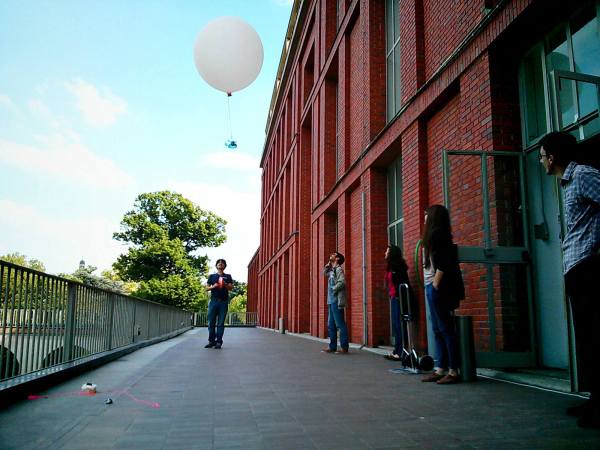
Aerial Mapping at Triennale
In May 2013 I organized with my partners at Wefab, a 2-day workshop of DIY Aerial Mapping to introduce to
 ZOESCOPE