Open Design e Open Brand, da Serpica Naro alla digital fabrication

A completare il percorso didattico del Master Relational Design, ogni mese sono previste talks online, in cui professionisti, operanti in diversi campi disciplinari, sono invitati a raccontare le proprie esperienze lavorative e a condividere la loro expertise con gli studenti. La talk che ho tenuto lo scorso 17 Giugno 2014 ha introdotto le esplorazioni del concetto di open design dalle sperimentazione avvenute con Serpica Naro a partire dal 2005, passando per il progetto europeo Openwear sino ad arrivare alle esperienza di costruzione del makerspace WeMake a Milano. Link utili: – Licenza Serpica Naro http://serpica.tumblr.com/Licenza http://epress.lib.uts.edu.au/journals… http://www.digicult.it/it/digimag/iss… http://www.serpicanaro.com/research/r… – Licenza Openwear http://openwear.org/info/license http://issuu.com/openwear/docs/openwe… – Articoli http://www.chefuturo.it/2012/04/artig… http://www.chefuturo.it/2013/10/maker… http://www.chefuturo.it/2013/02/speri… http://www.chefuturo.it/2012/11/la-st… http://www.chefuturo.it/2012/06/il-de… http://www.digicult.it/it/digimag/iss… http://www.digicult.it/it/digimag/iss… Zoe Romano Laureata in filosofia e appassionata di tecnologia, ha partecipato alla creazione di iniziative di attivismo sociale sulla precarietà come San Precario e il suo anagramma Serpica Naro. Ha co-fondato il progetto pilota europeo di moda collaborativa Openwear.org attivo dal 2009 al 2012 e Wefab.it, una serie di eventi

read more Open Design e Open Brand, da Serpica Naro alla digital fabrication
Makers, stampa 3d e copyright

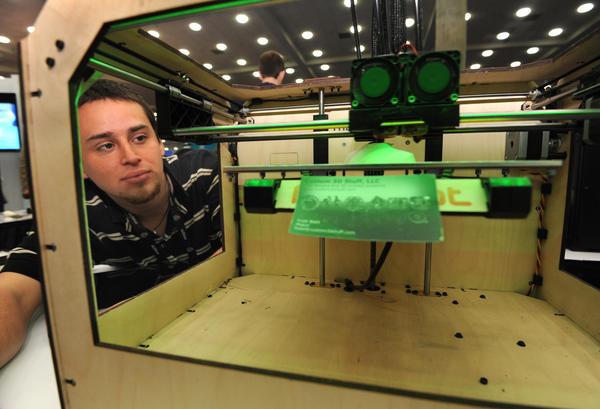
(originally created and posted on Doppiozero) Todd Blatt è un ingegnere meccanico di Baltimora appassionato di fantascienza e fantasy. Da un paio di anni passa il suo tempo a ricreare oggetti presenti nei film di genere di cui è appassionato. Todd frequenta anche la comunità online theRPF, i cui i membri condividono trucchi e istruzioni per realizzare i complementi di costumi accessoriati. Fin dagli anni ’90, gli utenti di theRPF sono una sorta di makers ante litteram che per dimostrare il proprio amore per un particolare film o serie tv si divertono a travestirsi come i personaggi, ricostruendo i materiali di scena, magari facendo crescere la propria reputazione online fino a riuscire a partecipare da protagonisti a una convention di Star Trek. E’ la principale “Prop community”, dall’inglese “Theatrical property”, materiali di scena. Todd Blatt Todd però è un prop diverso dagli altri. Perché i suoi accessori non sono realizzati con tecniche di artigianato classico, come la maggior parte degli altri; sono progettati

read more Makers, stampa 3d e copyright

Knitic project, or how to give a new brain to knitting machines

  (originally created and posted on Arduino blog) Knitic is an open source project which controls electronic knitting machines via Arduino. To be more precise, Knitic is like a new ‘brain’ for the Brother knitting machines allowing people to create any pattern and modify them on the fly. Knitic kit is composed by an Arduino Due, a diy printed circuit board on top of it, connected to the electronic parts of the original machine, (like end-of-line sensors, encoder, and 16 solenoids) and a software to control the needles real-time. In the past days I interviewed Varvara & Mar, the duo who developed the project. They’ve been working together as artists since 2009 and their artistic practices lay at the intersection between art, technology, and science. When I run into their project I immediately liked their approach as they see knitting machines as the first real domestic fabrication tool, that has been  overlooked in the age of digital fabrication. Check the

read more Knitic project, or how to give a new brain to knitting machines

3d printing and wood at Paris fashion week

An experimental new material was put to use in the creation of a flexible, soft dress of stunning complexity, produce with Laser Sintering technique. Austrian architect Julia Koerner explains, “My collaboration with Materialise for the 3D printed dress for Iris van Herpen’s Haute Couture Show ‘Voltage’ 2013 reveals a highly complex, parametrically generated, geometrical structure. The architectural structure aims to superimpose multiple layers of thin woven lines which animate the body in an organic way. Exploiting computational boundaries in combination with emergent technology selective laser sintering, of a new flexible material, lead to enticing and enigmatic effects within fashion design. New possibilities arise such as eliminating seams and cuts where they are usually placed in couture.” Learn more here Using a different technique and approach, Sruli Recht items are made of layers of walnut wood divided into triangles and then mounted on a textile base forming the geometric shapes of the garments. Take a look at the video below (and spot

read more 3d printing and wood at Paris fashion week